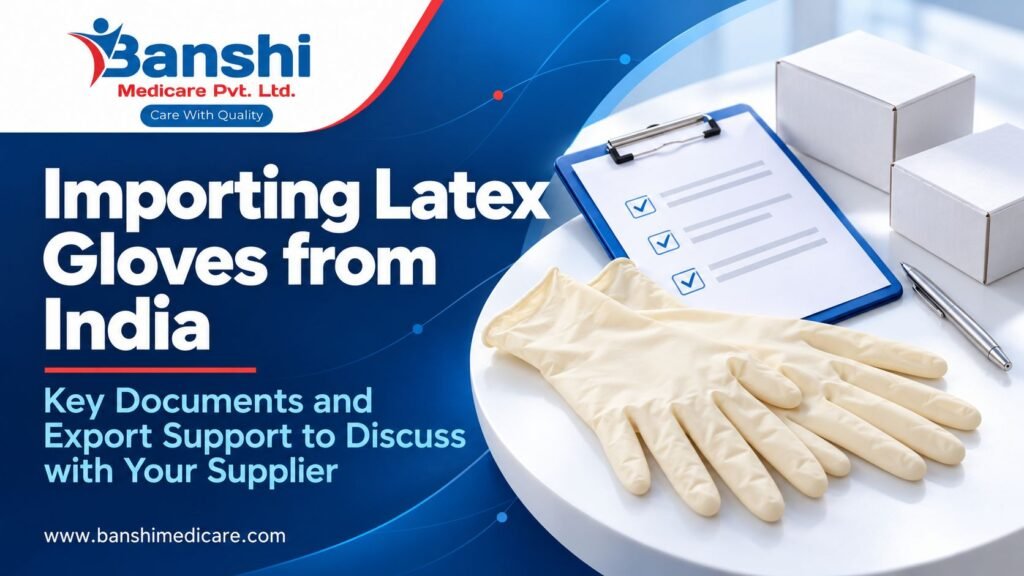
Importing Latex Gloves from India: Key Documents and Export Support to Discuss with Your Supplier
Importing latex gloves from India requires clear product specifications, suitable documentation, and an agreed plan for shipment and delivery. At Banshi Medicare Private Limited, we manufacture and export medical gloves, including latex surgical and examination options. For bulk purchasing and export enquiries, contact us with your destination country, glove requirements, and estimated quantities. Before confirming an order, establish which documents your market requires and what assistance your supplier can provide. This helps both parties identify missing information, assign responsibilities, and prepare the shipment against a shared checklist. Define the Exact Latex Gloves You Need Start by identifying whether you need surgical or examination gloves. Then specify powder status, sterility, sizes, quantities, and packaging. Banshi Medicare lists powder-free and pre-powdered latex surgical and examination gloves in its portfolio. Confirm the current specifications and destination-market suitability of your selected product. For example, the US FDA bans powdered surgeon’s gloves and powdered patient examination gloves. A product appearing in a supplier’s catalogue does not establish that it can be imported into every country. Your enquiry should include: Product category and intended use. Powder status and sterile or non-sterile requirements. Quantity for each size. Packing configuration and labeling needs. Minimum remaining shelf life expected on arrival. Destination country and preferred delivery location. Natural rubber latex may cause allergic reactions. Powder-free latex gloves still contain latex, so product selection should also account for the receiving healthcare organization’s material requirements. Confirm Import Requirements Before Placing the Order Ask your local regulatory team or qualified adviser to establish the requirements for your selected gloves. These may involve product registration, importer authorization, labeling, and supporting manufacturer documents. Give the supplier your document checklist early. Ask whether each item is available, which products it covers, and how long preparation will take. Keep registration preparation separate from shipment booking. Where authorization is required before import, resolve that requirement before dispatch. Key Commercial and Shipping Documents to Review Common international trade documents include the following. The final requirements depend on your destination and transaction. Document What to Verify Pro forma invoice Proposed products, quantities, prices, currency, and commercial terms Commercial invoice Buyer and seller details, goods sold, quantities, and transaction values Packing list Carton contents, package counts, weights, and dimensions Air waybill or bill of lading Transport details, consignee information, and shipment reference Certificate of origin, where required Product origin and the accepted certificate format A packing list does not replace a commercial invoice. Cross-check product descriptions and quantities across the documents. Ask your customs broker to confirm required copies, language, originals, and any additional paperwork. Review draft documents before dispatch so corrections can be made before the shipment moves. Manufacturer, Quality, and Product Documents to Discuss Ask for manufacturer and product documents relevant to the exact gloves you intend to purchase. Depending on your market and procurement process, your checklist may include: Relevant manufacturing license and product coverage. Current product specification and instructions for use. Applicable quality-management certificates. Available test reports or performance summaries. Sterilization and batch-release documentation for sterile products. Free Sale Certificate, where requested by the destination authority. CDSCO publishes guidance for licensed Indian medical device manufacturers obtaining Free Sale Certificates for export purposes. If your market requests one, confirm availability, product coverage, validity, and acceptance before ordering. For every certificate supplied, check the manufacturer name, site address, scope, and issuing organization. A company certificate should not be treated as proof that every product is authorized in every market. Export Support to Agree with Your Supplier “Export support” can cover several tasks. Ask the supplier to define the assistance included in your quotation and identify any additional charges. Support Area Questions to Discuss Product selection Can the team provide current specifications and confirm the required size mix? Document preparation Which documents are available, and when can drafts be reviewed? Packaging and artwork Can proposed labels and carton markings be reviewed before production? Freight coordination Who books transport, communicates with the forwarder, and provides tracking? Order updates Who reports production progress, dispatch readiness, and schedule changes? After-delivery support What is the process for shortages, damage, or product complaints? Record the agreed responsibilities in writing. For example, if your company appoints the freight forwarder, clarify which shipment details the supplier must provide and by what date. Supplier assistance should be coordinated with your importer, broker, and regulatory team. Agree on who makes the final submissions and who responds to requests from local authorities. Review Packaging, Labeling, and Shelf Life Request proposed label artwork and packaging details before approving the order. Check product identification, material, size, batch information, expiry, manufacturer details, and required warnings or language. For sterile gloves, discuss the individual packaging configuration and the receiving checks for damaged pouches or seals. Confirm the storage conditions shown on the current product label and plan transport and warehousing accordingly. Also agree on remaining shelf life at arrival. A product’s total shelf life from manufacture does not tell you how much usable shelf life will remain after production, shipment, and clearance. For wholesale orders, define quantities consistently. State whether each figure refers to individual gloves, pairs, boxes, or cartons. Agree on Commercial Terms and Shipping Responsibilities Your quotation should make the order’s costs and responsibilities clear. Review: Minimum order quantities and size combinations. Price basis, currency, and quotation validity. Payment terms and any bank charges. Production lead time and estimated dispatch date. Agreed Incoterms and named delivery point. Freight, insurance, and customs-clearance responsibilities. Charges for special artwork or additional document preparation. Compare the total landed cost rather than the product price alone. Ask your broker to confirm applicable classification, duties, taxes, and clearance costs for the destination. For recurring purchases, discuss demand forecasts and replenishment timing without assuming that future lead times will remain unchanged. Complete a Final Review Before Dispatch Use one checklist shared by the buyer, supplier, and logistics team. Confirm the approved product references, quantities, labels, packing details, document set, and delivery instructions. Resolve discrepancies before shipment. Keep the purchase order, approved artwork, agreed specifications, and shipment documents […]